 Accessibility
 Increase Font
 Decrease Font
 Greyscale
 Highlight Links
 Regular Font
 Reset

Beyond the Classroom: When Home and School Learn Together
Imagine a Grade 10 student coming home after learning the story of Ruth in Jewish Studies. Over dinner, she mentions Ruth’s decision to leave her homeland, prompting her grandmother to share her own family's migration story. What began as a classroom lesson becomes a meaningful conversation about family history, belonging, and identity. The next morning, the student returns to school with a deeper understanding and a new perspective to share.
This is the power of a strong home-school partnership. When learning extends beyond the classroom and becomes part of family conversations, students make connections that deepen their understanding, strengthen their critical thinking, and enrich their educational experience.
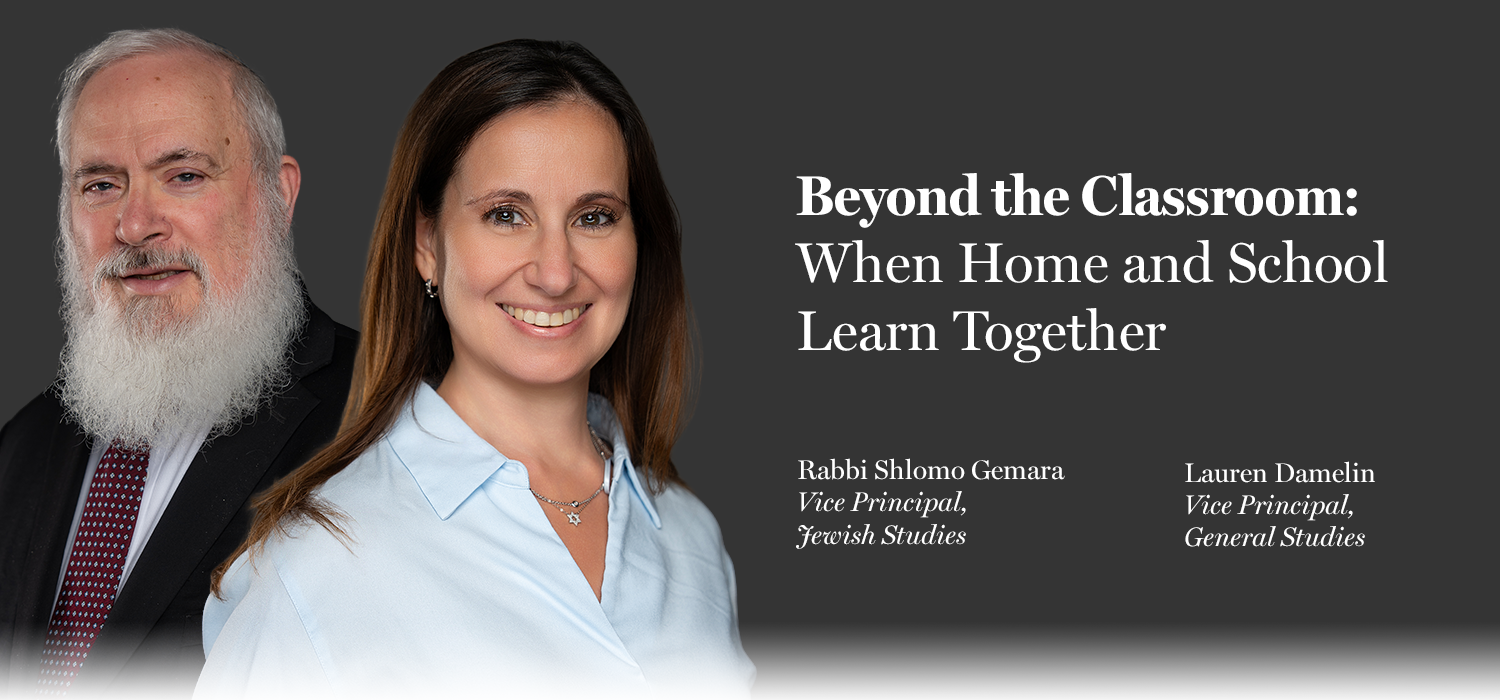
As Vice Principals of General Studies and Jewish Studies, we approach education through different disciplines, but share a common belief: academic excellence in a dual curriculum environment is a collective effort. It is strengthened when educators and families work together to create an environment where students are challenged, supported, and encouraged to reach their full potential.
In our roles, we have the privilege of working closely with teachers and students to help shape the learning experiences that take place in our classrooms every day. While our areas of focus may differ, our conversations often return to the same questions: How can we challenge students to think more critically? How do we support them when learning becomes difficult? And how do we ensure they develop the skills and confidence to succeed beyond high school? These questions reflect our shared commitment to academic excellence, Jewish literacy, a strong connection to Israel, and an outstanding student experience.
In General Studies, academic excellence means more than mastering course content or earning top grades. It means developing critical thinking, independence, resilience, and the confidence to tackle unfamiliar challenges. In Jewish Studies, these same skills are strengthened through the exploration of Jewish texts, history, values, and contemporary issues, encouraging students to question, interpret, and connect their learning to their own lives. Together, these disciplines reinforce one another, helping students become thoughtful, curious, and confident learners who can approach complex questions from multiple perspectives.
Families are essential partners in this work. Whether discussing current events at the dinner table, encouraging a child to work through a challenging assignment, or simply asking thoughtful questions about what they are learning, parents reinforce the habits of curiosity, reflection, and critical thinking developed at school. These everyday interactions remind students that learning is not confined to the classroom and that their education has meaning and relevance beyond it.
Perhaps the true measure of academic excellence is not just what students retain when they leave the classroom, but the meaningful conversations they start when they arrive home. Our hope is that every graduate leaves TanenbaumCHAT, supported by both home and school, with a strong Jewish identity, a solid academic foundation, and the skills and confidence to flourish in the next chapter of their lives.
Sincerely,

Rabbi Shlomo Gemara
Vice President, Jewish Studies
Lauren Damelin
Vice President, General Studies